


What Does Setting the Edge Mean in Football?
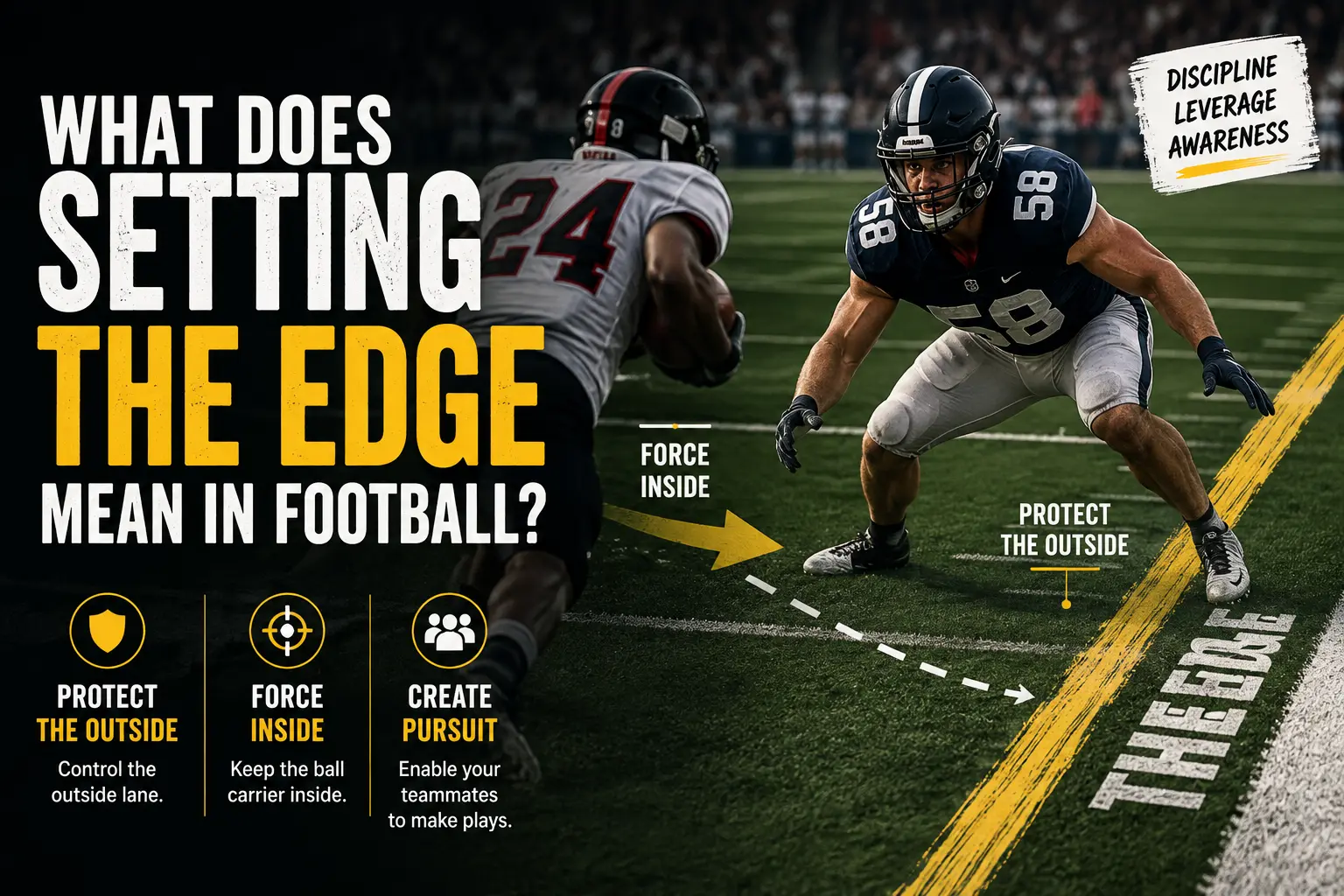
Setting the edge in football means preventing the ball carrier from escaping around the outside of the defense. The defender responsible for the edge keeps outside leverage, maintains contain and forces the play back toward teammates in the middle of the field.
It sounds simple, but edge discipline is one of the foundations of good run defense. A defender can make a successful play without recording a tackle at all: if he takes away the outside lane and forces the runner back into pursuit, he has done his job.
What Does “Setting the Edge” Mean in Football?
The “edge” is the outside boundary of the defensive front. On a running play, the offense often wants to get the ball carrier around that boundary and into open space.
The defender assigned to protect it is commonly called the edge defender or force defender. His primary responsibility is to stop the runner from turning the corner.
In practical terms, setting the edge usually means:
- maintaining outside leverage;
- keeping the runner inside;
- avoiding being sealed or blocked toward the middle;
- staying disciplined rather than chasing the football too early; and
- funneling the play toward pursuing defenders.
USA Football coaching materials describe a similar principle when teaching edge technique: defenders contain the run while keeping the outside arm and leg free. You can find additional defensive coaching resources at USA Football.
Why Is Setting the Edge So Important?
A defense is designed around players fitting together. Interior defensive linemen control gaps, linebackers pursue the ball and defensive backs provide support. If the outside defender loses contain, much of that structure can disappear immediately.
A running back who gets outside may suddenly have open field, blockers in front of him and defensive players pursuing from poor angles.
A properly set edge does the opposite. It reduces the runner’s options.
Instead of accelerating toward the sideline, the ball carrier may have to slow down, cut inside or change direction. That gives the rest of the defense time to close.
A good edge defender does not always make the tackle. Sometimes his most important contribution is deciding where the tackle will happen.
Who Is Responsible for Setting the Edge?
There is no single position that always owns the edge. Responsibility depends on the defensive front, coverage and offensive formation.
Defensive Ends
In many four-man fronts, the defensive end is the natural edge defender. He lines up outside or over the offensive tackle and must defend both the outside running lane and the quarterback on passing plays.
This creates an important balance: attacking too aggressively inside can create an escape route around the defender, while getting too wide can open a cutback lane between him and the rest of the defensive front.
Outside Linebackers
In odd fronts such as a traditional 3-4 alignment, an outside linebacker frequently has edge responsibility.
The linebacker may rush the passer on one play, defend the run on the next and occasionally drop into coverage. Regardless of the assignment, maintaining leverage becomes critical whenever he is responsible for contain.
Safeties and Cornerbacks
Defensive backs can also become force defenders, particularly against formations that spread the defense horizontally or use motion, screens and perimeter runs.
A safety rotating toward the line of scrimmage or a corner supporting the run may therefore become the player responsible for preventing the ball from reaching the sideline.
What Is Outside Leverage?
Outside leverage means positioning yourself between the ball carrier and the outside of the field.
If a defender responsible for contain moves too far inside, the runner can get around him. The defender therefore tries to keep his body and outside shoulder in a position that makes the outside route difficult or impossible.
The objective is not necessarily to drive the runner directly backward. It is often enough to make him hesitate or cut toward the interior of the defense.
In this sense, leverage is about controlling space rather than simply winning a collision.
How Does a Defender Set the Edge?
Good edge play begins before contact with the blocker.
1. Get the Alignment Right
The defender needs enough width to protect the perimeter without creating a large interior running lane. The exact position depends on the formation and defensive call.
2. Stay Square
Turning the shoulders too early makes it easier for a blocker to move the defender out of position. Staying square allows the edge player to react to both an outside run and a cutback.
3. Keep the Outside Side Free
Coaches often teach edge defenders to prevent a blocker from fully controlling their outside arm and leg. This helps the defender remain available if the runner tries to bounce the play outside.
4. Read the Block
The offensive line can provide early information about the play.
A reach block may indicate that the offense wants to stretch the defense horizontally. A pulling lineman may signal a sweep, power concept or counter. A tackle immediately setting for pass protection changes the defender’s responsibility again.
5. Force the Runner to Declare
The edge defender does not need to make a reckless move toward the football. Maintaining position can force the running back to commit to an inside path, where linebackers and defensive linemen are waiting.
Setting the Edge Against Outside Zone
Outside zone is one of the clearest examples of why edge discipline matters.
The offensive line moves laterally and attempts to stretch the defense. The running back then reads the blocks and chooses whether to continue outside, cut upfield or bend the run back inside.
An edge defender who collapses too aggressively toward the middle can give the running back an easy path around the formation. But a defender who widens too far can create a large interior cutback lane.
The goal is therefore controlled leverage: restrict the outside path without abandoning the inside relationship with the rest of the defense.
Setting the Edge Against Tosses and Sweeps
Tosses and sweeps put even greater pressure on the perimeter because the offense is deliberately trying to get the ball outside quickly.
The edge defender must recognize the play, maintain position and avoid being trapped inside by a tackle, tight end, receiver or pulling blocker.
If he can force the runner to slow down or cut back, defenders pursuing from the inside gain valuable time.
This is also why looking only at the box score can underestimate good edge play. The linebacker who eventually makes the tackle may receive the statistic even though another defender created the opportunity.
What About Read Options and Mobile Quarterbacks?
Option football makes edge assignments more complicated because the offense may intentionally leave the edge defender unblocked and read his decision.
Depending on the defensive call, the defender may be responsible for the quarterback, the running back or a specific gap.
Discipline becomes more important than simply attacking whoever appears to have the football first. Committing too early can make the quarterback’s read easy and open a running lane elsewhere.
The same concept applies against mobile quarterbacks on passing plays. An edge rusher who flies too far inside or too far beyond the quarterback can create an escape lane even while generating apparent pressure.
Setting the Edge vs. Rushing the Passer
An edge defender frequently has two jobs that can appear to conflict with each other.
Against the run, he wants to maintain structure and leverage. Against a pass, he may want to explode off the line and attack the quarterback.
Elite edge players are valuable because they can do both.
On a clear passing down, the defender can use speed, power and hand technique to get around the offensive tackle. But rush-lane discipline still matters, especially against quarterbacks capable of escaping the pocket.
For more on how the position is classified and measured statistically, Pro Football Reference provides player, team and historical NFL data.
What Is the Difference Between an Edge Defender and an Edge Rusher?
The terms overlap, but they do not mean exactly the same thing.
An edge defender describes where a player operates and the responsibilities associated with defending the perimeter.
An edge rusher emphasizes the player’s role attacking the quarterback from the outside of the offensive formation.
A defensive end or outside linebacker can be both.
Modern football increasingly uses the general label EDGE because defensive schemes do not always fit neatly into the traditional distinction between defensive ends and outside linebackers.
How Do Coaches Measure Good Edge Play?
Sacks and tackles for loss are the obvious statistics, but neither tells the whole story.
Coaches can also evaluate:
- whether the defender maintained contain;
- how often runs reached the outside;
- whether the defender forced cutbacks;
- missed tackles;
- quarterback pressures;
- rush-lane discipline;
- ability to defeat or control blocks; and
- whether the player executed his assignment within the defensive scheme.
The official NFL site maintains current league information, rules and football terminology at NFL.com, while the league’s football operations site publishes the official NFL rulebook.
Why a Defender Can Set the Edge Without Making the Tackle
This is perhaps the most important point for fans trying to understand defensive football.
Football is not a collection of isolated one-on-one plays. Defensive assignments are designed to complement each other.
Imagine an outside run in which the edge defender takes on a blocker and forces the running back to cut toward the middle. A linebacker then arrives and makes the tackle for a two-yard gain.
The stat sheet credits the linebacker.
The film may show that the edge defender made the play possible.
That distinction is one reason coaches and analysts use game film alongside conventional statistics when evaluating defensive players.
Quick Football Glossary
- Set the edge
- Control the outside boundary of the defense and prevent the ball carrier from escaping around the formation.
- Contain
- Keeping the ball carrier or quarterback inside the defensive structure rather than allowing an outside escape.
- Outside leverage
- Positioning that keeps the defender between the offensive player and the outside of the field.
- Force defender
- The defender responsible for forcing an outside run back toward defensive pursuit.
- Edge rusher
- A defender who attacks the quarterback from the outside of the offensive front.
- Cutback
- A change of direction by the ball carrier, often from an outside path toward an interior running lane.
Final Take
Setting the edge means taking away the outside of the field. The defender maintains leverage, prevents the runner from freely turning the corner and directs the play toward defensive help.
The best edge defenders combine strength, positioning, awareness and patience. They can rush the quarterback when the opportunity appears without forgetting that defending space is often just as important as chasing the football.
Once you start watching for the edge rather than only following the ball, run defense becomes much easier to understand. A defender who appears to be doing very little may actually be the player determining where the entire play can go.